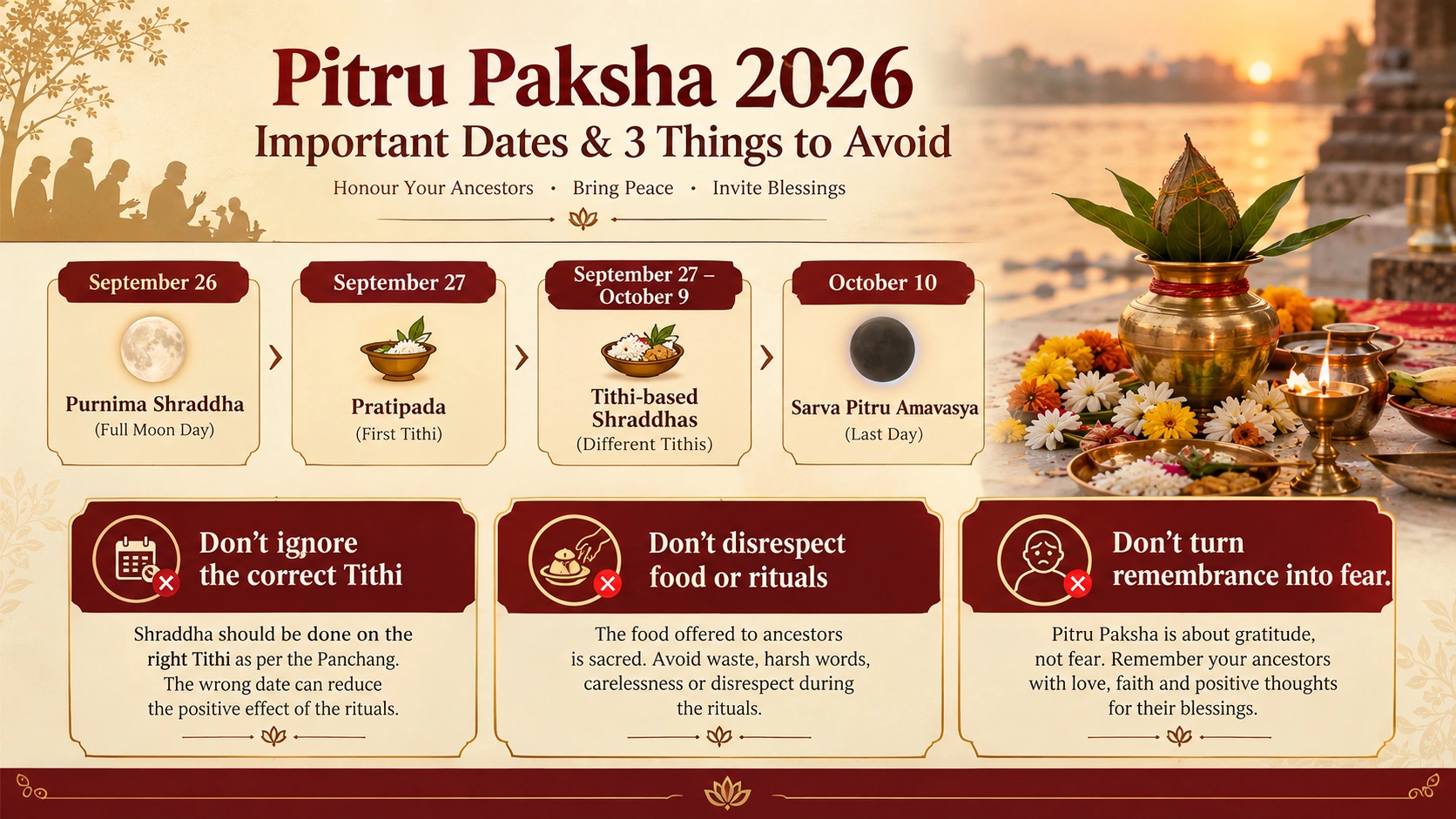
Pitru Paksha 2026 begins around September 26, and this is the time when many Hindu families traditionally remember their ancestors through Shraddha, Tarpan, prayers and charitable acts. But there are also certain practices that are traditionally avoided during this period.
If you are preparing for Pitru Paksha 2026, remember these three things:
1. Do not perform Shraddha casually or without understanding the correct Tithi.
2. Do not disrespect food, elders, guests or the people involved in ancestral rituals.
3. Do not turn Pitru Paksha into a period of fear, arguments or unnecessary superstition.
The purpose of Pitru Paksha is traditionally associated with gratitude, remembrance and offering respect to ancestors—not fear.
Pitru Paksha 2026 Start Date: Is It September 26?
Yes, September 26, 2026, is the Purnima Shraddha day that precedes the main Pitru Paksha sequence, while Pratipada Shraddha falls on September 27. Panchang calculations can vary by location, so people should check their local Panchang before fixing an exact Shraddha time.
The 2026 sequence listed by Panchang sources continues through October, ending with Sarva Pitru Amavasya on October 10, 2026.
Important distinction
Some calendars and articles use September 26 as the beginning of the Pitru Paksha period, while the first regular Pratipada Shraddha is observed on September 27.
So, for your article, the safest wording is:
Pitru Paksha 2026 begins around September 26, with Pratipada Shraddha on September 27.
This avoids confusing readers who see different dates in different Panchangs.
What Is Pitru Paksha?
Pitru Paksha, also called Shraddha Paksha or Mahalaya Paksha, is a period traditionally dedicated to remembering deceased ancestors.
Families may perform rituals such as:
-
Shraddha
-
Tarpan
-
Pinda Daan
-
Offering food
-
Offering water
-
Charity
-
Prayers for ancestors
-
Feeding Brahmins or people in need according to family tradition
The central idea is Shraddha—faith, respect and remembrance.
Traditional sources describe Pitru Paksha Shraddhas as Tithi-based rituals, meaning the lunar date associated with an ancestor's death is important when determining the appropriate day.
3 Things You Should Never Do During Pitru Paksha 2026
1. Don't Perform Shraddha Without Checking the Correct Tithi
This is one of the most important Pitru Paksha 2026 start date rules.
Many people simply choose a convenient date and perform the ritual. However, traditional Shraddha practice is generally based on the Tithi—the lunar date—associated with the ancestor's death.
For example, Panchang sources specifically list different Shraddha days for Pratipada, Dwitiya, Tritiya, Ekadashi, Chaturdashi and Amavasya.
What should you do instead?
If you know the death Tithi of your ancestor:
Follow that Tithi for the Shraddha according to your local Panchang.
If you do not know the death Tithi, don't panic.
Traditional practice provides specific options, including Sarva Pitru Amavasya, which is considered an important day for remembering ancestors when the specific Tithi is unknown.
Simple rule:
Known Tithi → follow the appropriate Shraddha Tithi.
Unknown Tithi → consult your family tradition or a knowledgeable priest/Panchang for Sarva Pitru Amavasya.
2. Don't Disrespect Food or Those Who Receive It
During Pitru Paksha, food offerings have an important traditional role.
That is why one of the most meaningful things to avoid is waste, disrespect or careless handling of food offered in memory of ancestors.
If your family tradition includes preparing food for Shraddha:
-
Prepare it with cleanliness.
-
Keep the atmosphere peaceful.
-
Avoid unnecessary arguments during the ritual.
-
Do not deliberately waste the food.
-
Follow your family's traditional method of offering and serving it.
In many traditions, feeding people, offering food and charity are important parts of remembering ancestors.
The deeper message is simple:
Food offered in remembrance should be treated with respect.
3. Don't Turn Pitru Paksha Into Fear and Arguments
This is perhaps the most overlooked rule.
Every year, people search:
“What happens if I don't perform Shraddha?”
“Will Pitru Dosha happen?”
“Will my business stop growing?”
“Will my marriage be delayed?”
These questions can create unnecessary anxiety.
Pitru Paksha is traditionally a period of remembrance and gratitude. It should not become an excuse to frighten family members or make unsupported predictions.
If you missed a ritual, do not immediately assume that something bad will happen.
Instead:
-
Speak to your family.
-
Check the correct Tithi.
-
Consult a trusted priest if needed.
-
Perform an appropriate ritual when possible.
-
Offer prayers and charity according to your tradition.
Respect is more meaningful than fear.
Pitru Paksha 2026 Calendar
Here is a simplified calendar for readers:
| Date | 2026 Shraddha |
|---|---|
| September 26 | Purnima Shraddha |
| September 27 | Pratipada Shraddha |
| September 28 | Dwitiya Shraddha |
| September 29 | Tritiya Shraddha |
| September 30 | Chaturthi & Panchami Shraddha |
| October 1 | Shashthi Shraddha |
| October 2 | Saptami Shraddha |
| October 3 | Ashtami Shraddha |
| October 4 | Navami Shraddha |
| October 5 | Dashami Shraddha |
| October 6 | Ekadashi Shraddha |
| October 7 | Dwadashi Shraddha |
| October 8 | Trayodashi Shraddha |
| October 9 | Chaturdashi Shraddha |
| October 10 | Sarva Pitru Amavasya / Mahalaya Amavasya |
This calendar follows the 2026 Shraddha sequence published for Indian locations; exact ritual timings are location-specific.
What Is the Best Time for Pitru Shraddha?
Traditional Parvan Shraddha is generally associated with the afternoon period, with Panchang sources identifying Kutup and Rohina Muhurats and the subsequent Aparahna period as important windows.
However, do not copy another city's Shraddha time.
For example, the available 2026 Panchang timings differ between locations because sunrise and local astronomical calculations differ.
What time should Pitru Shraddha be performed?
Traditionally, Pitru Shraddha is performed during the appropriate Aparahna period, with specific Muhurats such as Kutup and Rohina considered important. The exact time should be checked using the Panchang for your city.
What Should You Do During Pitru Paksha?
Instead of focusing only on restrictions, follow a few positive practices.
1. Remember Your Ancestors
Take a few minutes to remember your parents, grandparents and earlier generations.
Think about what they contributed to your family.
2. Offer Water
If Tarpan is part of your family tradition, perform it according to the prescribed method.
3. Offer Food
Follow your family's Shraddha tradition for food offerings.
4. Donate
Charity is traditionally associated with Pitru-related observances.
You can consider donating:
-
Food
-
Clothes
-
Essential household items
-
Educational supplies
-
Money to a legitimate charitable organisation
5. Feed People
If your family tradition includes feeding Brahmins, relatives, guests or people in need, follow that practice respectfully.
Can You Buy New Things During Pitru Paksha?
This is one of the most common searches every year.
There is no single universal rule followed identically by every Hindu family or region regarding every type of purchase during Pitru Paksha.
Some families traditionally avoid major auspicious purchases or ceremonies during this period, while others follow different regional practices.
So rather than declaring:
“Buying anything during Pitru Paksha is forbidden,”
it is better to say:
Follow your family's tradition and local Panchang for major purchases or ceremonies.
Can You Start a New Business During Pitru Paksha?
Again, traditions vary.
Some families avoid beginning major auspicious ventures during Pitru Paksha because the period is primarily dedicated to ancestral remembrance.
If a business decision is unavoidable, there is no need to create unnecessary fear.
For an important launch, ceremony or investment, you can consult your family's customary Panchang and choose a suitable date if that is important to you.
Pitru Paksha and Kundli: Is Pitru Dosha the Same Thing?
No.
This distinction is extremely important for anyone searching for Kundli information.
Pitru Paksha is a calendar period dedicated to ancestral remembrance and Shraddha practices.
Pitru Dosha, as discussed in Jyotisha traditions, is a separate concept interpreted through a person's birth chart.
Therefore:
Missing one Pitru Paksha ritual does not automatically mean your Kundli has Pitru Dosha.
A Kundli-based interpretation requires examining the relevant planetary combinations and the complete birth chart rather than making a conclusion from one missed ritual.
What If You Cannot Perform Shraddha on Every Tithi?
Don't panic.
Traditional Panchang sources identify Sarva Pitru Amavasya as an important day for performing Shraddha for ancestors when the exact death Tithi is unknown or when a family cannot perform separate Shraddha on every Tithi.
In 2026, Sarva Pitru Amavasya falls on October 10 in the cited West Bengal Panchang.
This is why the final day of Pitru Paksha is especially significant for many families.
5 Simple Rules to Remember This Pitru Paksha
If you don't want to remember a long list, remember these five:
1. Respect your ancestors.
2. Check the correct Tithi before Shraddha.
3. Treat food offerings with respect.
4. Avoid unnecessary arguments and disrespect during the observance.
5. Don't let fear-based claims replace tradition, common sense and proper guidance.
Final Thought
Pitru Paksha is not simply about following a list of things you are “allowed” or “not allowed” to do.
At its heart, it is traditionally a period to pause and remember the people whose lives came before ours.
September 26, 2026, marks the beginning of the Purnima Shraddha phase, with Pratipada Shraddha on September 27. The observance continues through the lunar Tithis until Sarva Pitru Amavasya on October 10.
If you know the appropriate Tithi, follow it.
If you don't know it, seek proper guidance.
If you cannot perform an elaborate ritual, don't let fear take over.
Remember your ancestors with sincerity, offer what you can, help someone in need and keep the atmosphere of your home peaceful.
That is a far more meaningful way to observe Pitru Paksha 2026.
